
Diverter Valves

Want to find out more about this offering?

Get in touch

High-Precision Diverter Valves for Reliable, Efficient Material Flow

Coperion diverter valves are engineered to deliver accurate, dependable flow direction in even the most demanding bulk material handling and pneumatic conveying systems. Backed by decades of experience and deep process expertise, every valve is developed and manufactured in-house using proprietary designs and high-quality materials ensuring long service life, exceptional sealing performance, and consistent product handling.

Our diverter valves are trusted across the plastics, chemical, food, and minerals industries for their ability to route materials safely, efficiently, and with minimal product degradation. 

Whether your process requires sanitary construction, abrasion resistance, or certified ATEX compliance, Coperion provides diverter valves built to excel under tough operating conditions.

Looking for the best diverter valve for your system?

Use our product filter to quickly find the model that fits your process requirements.
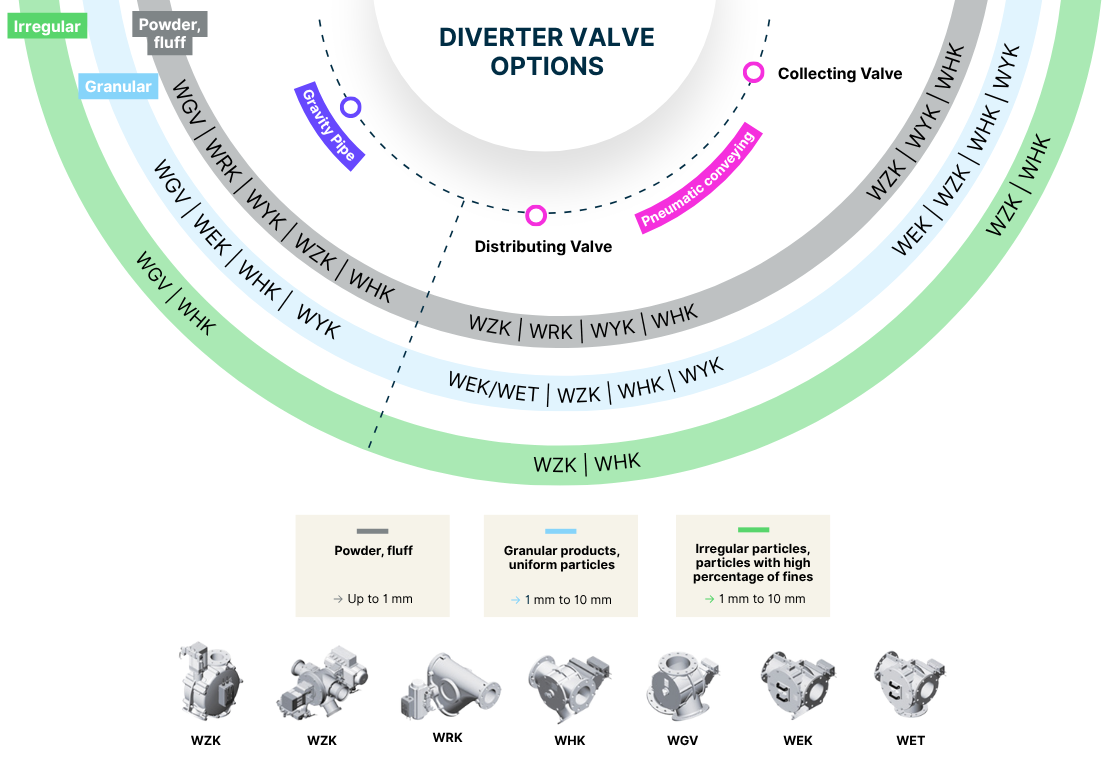
Find the Right Rotary Valve for Your Needs!

Product Filter

Explore our broad range of rotary valves to quickly narrow down your choices based on material and type of valve. Whether you need a valve for powders, granules, or other bulk materials, our intuitive filter will guide you to the perfect match.

Product Filter

Applicatios and Design Options

With multiple design options, we offer the right configuration for virtually any application:

  • K Design: Asymmetric diverter with a 35°- 45° angle, ideal for distributing or collecting materials in conveying lines and gravity pipes.

  • T Design: Rectangular diverter with a 90° angle, specifically engineered for precise and efficient silo filling.

  • V Design: Symmetric diverter with a 50° angle, optimized for smooth material direction in gravity lines.

Coperion diverter valves are designed for efficient handling of powders and granular products. They operate effectively within a pressure range of up to 6 barg (87 psi), ensuring reliable performance in demanding environments. Additionally, they can withstand operation temperatures of up to 100°C (212°F), allowing for versatility in applications that require temperature control. 

Coperion offers a broad variety of rotary valves for different bulk materials - both for discharging and pneumatic conveying

Plastics Industry

Reliable diverter valves for precise, gentle, and efficient handling of powders, pellets, and granules

Coperion diverter valves ensure smooth, gentle, and efficient routing of plastics raw materials. Optimized for feeding, conveying, dosing, and blending, they minimize wear and contamination while boosting process reliability across all production stages.

PLASTIC APPLICATIONS

Chemicals Industry

High-performance diverter valves for precise, reliable, and safe handling of powders and granules

Coperion diverter valves provide dependable routing of powders and granules in chemical processing, ensuring consistent flow, minimal wear, and reduced contamination. Robust design and process expertise deliver efficient conveying and reliable operation across a wide range of chemical applications.

CHEMICAL APPLICATIONS

Food Industry

Hygienic diverter valves for safe, reliable food processing

Coperion diverter valves are designed for sanitary, hygienic handling of powders and granules in food production. Optimized for conveying, dosing, and discharge, they ensure easy cleaning, contamination-free operation, and reliable performance in even the most demanding food processing applications.

FOOD APPLICATIONS

Minerals Industry

Durable diverter valves with advanced wear protection

Coperion diverter valves are engineered to handle highly abrasive powders and granules in mineral processing. With proven wear protection concepts, they ensure long service life, reliable routing, and consistent operation even under the toughest bulk material conditions.

MINERALS APPLICATIONS
1/4

Rotary Valve Basics Explained: Expert Guides and Technical Insights

NEW TO DIVERTER VALVES? WE'RE HERE TO HELP!

Exploring the realm of diverter valves can be daunting, particularly for those unfamiliar with their operation. Gaining insight into their functionality, various types, and practical applications is essential for enhancing efficiency across multiple sectors. This FAQ section answers some of the most frequently asked questions. If you have specific needs or require further assistance, feel free to reach out to our knowledgeable team!

  • What Materials Are Diverter Valves Made Of?

    The housing of a diverter valve is typically constructed from materials such as gray cast iron, stainless steel, or aluminum, selected based on the specific application and process requirements. The rotor is usually made from carbon steel or stainless steel, chosen to match the housing material and ensure long-lasting durability.

    These material options allow diverter valves to be tailored for various industries and operating conditions, ranging from standard bulk handling to applications that demand hygienic, corrosion-resistant, or abrasion-resistant features.

  • How Much Does a Diverter Valve Cost?

    The cost of a rotary valve varies depending on several factors, including the valve size, material of construction, application requirements, and any additional components or custom features.

    As a general guideline, prices for rotary valves typically range from a few thousand euros for standard models up to several tens of thousands of euros for specialized or heavy-duty designs. Choosing the right configuration ensures the best balance between performance, durability, and investment cost for your specific bulk material handling process.

  • When Is a Rotary Valve Suitable as an ATEX Explosion Protection System?

    A rotary valve can function as an ATEX-certified explosion protection system when it is specifically designed to prevent the propagation of an explosion from one part of a plant to another.

    To qualify as an explosion isolation device, the valve must demonstrate sufficient pressure resistance and prove that an ignited flame or spark on one product side cannot pass through to the other. This ensures that a potential explosion is contained and isolated within a defined section of the process.

    The certification process for ATEX rotary valves is conducted by an independent, notified body, verifying compliance with the EU ATEX Directive and relevant safety standards for explosion protection.

    Learn more about our ATEX services.

  • When Can a Rotary Valve Be Installed in an Ex Zone?

    A rotary valve can only be installed in an Ex zone (explosive atmosphere) if it is proven that the valve itself does not act as an ignition source. Potential ignition sources can include excessive surface temperatures, mechanically generated sparks, or electrostatic discharges.

    Depending on the zone classification and category, any foreseeable malfunctions must also be evaluated to ensure safe operation. In certain cases, verification and approval by an independent, notified body may be required to confirm compliance with ATEX directives and explosion protection standards.

Submit Your Questions

DOWNLOADS

Subscribe to the Coperion Newsletter