
Diverter Valves

Want to find out more about this offering?

Get in touch

High-Precision Diverter Valves for Reliable, Efficient Material Flow

Coperion diverter valves are engineered to deliver accurate, dependable flow direction in even the most demanding bulk material handling and pneumatic conveying systems. Backed by decades of experience and deep process expertise, every valve is developed and manufactured in-house using proprietary designs and high-quality materials ensuring long service life, exceptional sealing performance and consistent product handling.

Our diverter valves are trusted across the plastics, chemical, food, and minerals industries for their ability to route materials safely, efficiently and with minimal product degradation. 

Whether your process requires sanitary construction oabrasion resistance, Coperion provides diverter valves built to excel under tough operating conditions.

Looking for the best diverter valve for your system?

Use our product filter to quickly find the model that fits your process requirements.
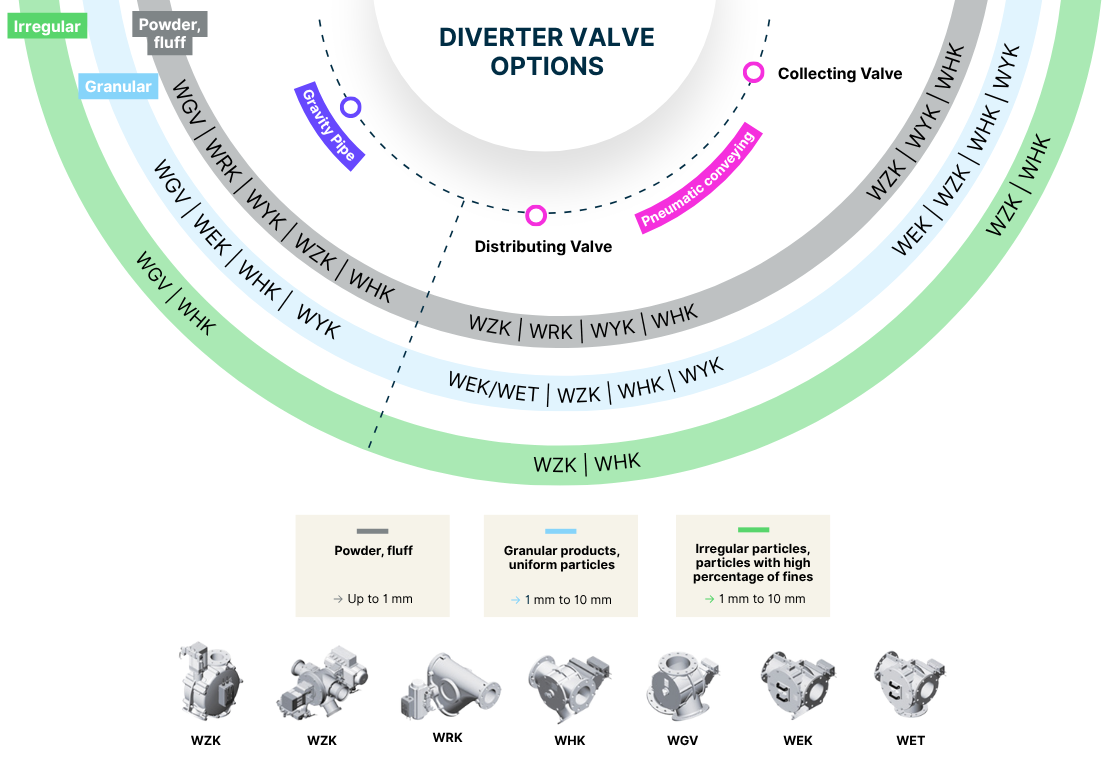
Find the Right Diverter Valve for Your Needs!

Product Filter

Discover our comprehensive selection of diverter valves and easily refine your options by valve type and material. Whether you're handling powders, granules, pellets or other bulk solids, our easy-to-use filter helps you identify the most suitable solution for your application.

Product Filter

Coperion Diverter Valve Applications and Design Options

With multiple design options, we offer the right configuration for virtually any application:

  • K Design: Asymmetric diverter with a 35°- 45° angle, ideal for distributing or collecting materials in conveying lines and gravity pipes.

  • T Design: Rectangular diverter with a 90° angle, specifically engineered for precise and efficient silo filling.

  • V Design: Symmetric diverter with a 50° angle, optimized for smooth material direction in gravity lines.

Our diverter valves are designed for efficient handling of powders and granular products. They operate effectively within a pressure range of up to 6 barg (87 psi), ensuring reliable performance in demanding environments. Additionally, they can withstand operation temperatures of up to 100°C (212°F), allowing for versatility in applications that require temperature control. 

Coperion offers a comprehensive range of diverter valves for pneumatic conveying systems, enabling reliable and efficient routing of powders, granules and other bulk materials.

Plastics Industry

Reliable diverter valves for precise, gentle, and efficient handling of powders, pellets, and granules.

Coperion diverter valves ensure smooth, gentle, and efficient routing of plastics raw materials. Optimized for feeding and conveying, they minimize wear and contamination while boosting process reliability across all production stages.

PLASTIC APPLICATIONS

Chemicals Industry

High-performance diverter valves for precise, reliable and safe handling of powders and granules.

Coperion diverter valves provide dependable routing of powders and granules in chemical processing, ensuring consistent flow, minimal wear and reduced contamination. Robust design and process expertise deliver efficient conveying and reliable operation across a wide range of chemical applications.

CHEMICAL APPLICATIONS

Food Industry

Hygienic diverter valves for safe, reliable food processing.

Coperion diverter valves are designed for sanitary, hygienic handling of powders and granules in food production. Optimized for conveying and discharge, they ensure easy cleaning, contamination-free operation and reliable performance in even the most demanding food processing applications.

FOOD APPLICATIONS

Minerals Industry

Durable diverter valves with advanced wear protection.

Coperion diverter valves are engineered to handle highly abrasive powders and granules in mineral processing. With proven wear protection concepts, they ensure long service life, reliable routing and consistent operation even under the toughest bulk material conditions.

MINERALS APPLICATIONS
1/4

NEW TO DIVERTER VALVES? WE'RE HERE TO HELP!

Exploring the realm of diverter valves can be daunting, particularly for those unfamiliar with their operation. Gaining insight into their functionality, various types, and practical applications is essential for enhancing efficiency across multiple sectors. This FAQ section answers some of the most frequently asked questions. If you have specific needs or require further assistance, feel free to reach out to our knowledgeable team!

  • What is a diverter valve and how does it work?

    A diverter valve is used to direct the flow of bulk materials from one conveying line to another. It is an essential component in pneumatic conveying and gravity conveying systems, enabling manufacturers to route powders, pellets, granules and other bulk solids to different process steps or storage locations.

    At the heart of a diverter valve is a rotating internal body (rotor) with a through-bore that is mounted inside the valve housing. As the rotor turns around its axis, the through-bore aligns with different conveying channels, redirecting the material flow from one outlet to another. When the valve switches position, the active conveying line is opened while the inactive line is securely sealed. A well-designed diverter valve provides a smooth product path, minimizing pressure loss, product degradation, material build-up and the risk of cross-contamination.

    Choosing the right diverter valve depends on factors such as the conveyed material, operating pressure, temperature, abrasion and hygiene requirements. For demanding applications, reliable sealing, wear-resistant materials and a robust design are critical to ensure consistent conveying performance and long service life.

    Coperion diverter valves are designed for reliable operation in the plastics, chemical, food, minerals and other process industries. With application-specific designs, high-quality materials and decades of process expertise, they deliver precise material routing, excellent sealing performance and dependable operation even under challenging conveying conditions.

  • Where are diverter valves used?

    Diverter valves are used wherever bulk materials need to be routed from one conveying line to multiple destinations. They are a standard component in pneumatic conveying and gravity conveying systems, providing a reliable way to distribute materials throughout a production process without interrupting material flow.

    Typical applications include conveying materials to silos, day bins, mixers, reactors, packaging lines, extruders and downstream processing equipment. By eliminating the need for multiple dedicated conveying lines, diverter valves help simplify plant layouts, reduce installation costs, and increase process flexibility.

    They are widely used across industries that handle powders, pellets, granules, flakes and other bulk solids, including:

    • Plastics
    • Chemicals
    • Food and pet food
    • Minerals and industrial materials


    The choice of diverter valve depends on the process requirements. Hygienic designs are often selected for food applications, while wear-resistant versions are preferred for abrasive products. For pneumatic conveying systems, high sealing performance is essential to prevent air leakage, maintain conveying efficiency and avoid cross-contamination between conveying lines.


    Coperion offers a broad portfolio of diverter valves designed for both dilute- and dense-phase conveying applications, with solutions tailored to the material, process conditions and industry requirements.

  • What types of materials can be conveyed through a diverter valve?

    Diverter valves are designed to handle a wide range of bulk materials in both pneumatic conveying and gravity conveying systems. The suitable valve design depends on the material properties and the operating conditions of the process.

    Typical materials include:

    • Plastic pellets and regrind
    • Powders and fine chemicals
    • Granules and flakes
    • Food ingredients such as flour, sugar, starch, coffee and spices
    • Minerals, pigments and other abrasive bulk solids
    • Specialty chemicals


    When selecting a diverter valve, it is important to consider factors such as particle size, bulk density, abrasiveness, temperature, moisture content and flow behavior. These characteristics influence the valve design, sealing concept and material selection required for reliable operation and long service life.

    For sensitive products, the valve should provide a smooth conveying path to minimize particle breakage and product degradation. Abrasive materials require wear-resistant components, while hygienic applications may call for polished surfaces, dead-space-free designs and materials that comply with food industry standards.

    Coperion diverter valves are available in a range of designs and materials to suit virtually any bulk material handling application, combining reliable sealing with gentle product handling and high wear resistance where needed.

  • What is the difference between gravity pipes and pneumatic conveying diverter valves?

    The main difference lies in the way the material is transported and the requirements placed on the valve.

    Gravity diverter valves are used in gravity-fed systems, where bulk materials flow through the valve under their own weight. In these applications, the valve primarily ensures reliable material routing and smooth product flow. Since there is little or no pressure in the system, sealing requirements are generally less demanding.

    Pneumatic conveying diverter valves are designed for conveying systems that transport bulk materials using air pressure or vacuum. In addition to directing the material flow, they must provide a high level of sealing to prevent air leakage, maintain conveying efficiency and avoid cross-contamination between conveying lines. The internal geometry is also designed to minimize pressure loss and product degradation.

    The choice between a gravity and a pneumatic conveying diverter valve depends on the conveying method, operating conditions and the material being handled. Factors such as pressure, temperature, abrasiveness, hygiene requirements and the properties of the bulk material all influence the most suitable valve design.

    Coperion offers diverter valves for both gravity and pneumatic conveying applications, with designs optimized for reliable operation, excellent sealing performance and long service life under demanding process conditions.

  • What is the difference between a pipe diverter valve and a flap diverter valve?

    The main difference between a pipe diverter valve and a flap diverter valve is the design of the internal flow path.

    A pipe diverter valve uses a rotating rotor with integrated pipe sections that create a continuous round cross-section throughout the valve. As the rotor turns, these pipe sections align with the selected conveying line, providing a smooth and unrestricted product path. This design helps minimize pressure loss, product degradation and material build-up, making it ideal for demanding pneumatic conveying applications.

    A flap diverter valve, on the other hand, uses a pivoting flap to switch the material flow between outlets. Because the flap changes the geometry of the flow path, the cross-section varies throughout the valve. While flap diverter valves are suitable for many conveying applications, they generally do not provide the same continuous product flow as a pipe diverter valve.

    The best choice depends on the conveyed material, conveying method and process requirements. Pipe diverter valves are often preferred for applications requiring gentle product handling, high sealing performance and reliable conveying efficiency.

  • When should I use a diverter valve instead of multiple conveying lines?

    A diverter valve is the preferred solution when one conveying system needs to feed multiple destinations. Instead of installing separate conveying lines for each process step or storage vessel, a diverter valve allows the material flow to be switched quickly and reliably between different outlets.

    Using a diverter valve can reduce the number of pipelines, blowers, filters and other conveying components, resulting in a simpler system design, lower installation costs and reduced maintenance requirements. It also provides greater flexibility, making it easier to adapt the conveying system to changing production needs.

    Diverter valves are commonly used to distribute bulk materials to multiple silos, day bins, mixers, reactors, packaging lines or processing machines. They are suitable for both pneumatic conveying and gravity pipe systems, provided that only one conveying path is required at a time.

    For applications where different products are conveyed through the same system, selecting a diverter valve with excellent sealing performance is essential. A reliable seal helps prevent cross-contamination, minimizes air leakage in pneumatic conveying systems and ensures consistent conveying performance.

    Coperion diverter valves are designed to provide reliable switching, tight sealing, and long service life, making them an efficient solution for flexible bulk material handling systems.

  • Can diverter valves be used in dense-phase pneumatic conveying?

    Yes, diverter valves can be used in dense-phase pneumatic conveying systems when they are designed to handle the specific operating conditions of this conveying method. Dense-phase conveying transports bulk materials at lower conveying velocities and higher material concentrations compared with dilute-phase conveying, making it particularly suitable for sensitive, abrasive or high-value products.

    For these applications, the diverter valve must provide high sealing performance, robust construction and excellent wear resistance. The valve design needs to withstand the higher pressure conditions typically associated with dense-phase conveying while maintaining a reliable seal to prevent air leakage and ensure efficient material transport.

    The selection of a suitable diverter valve depends on several factors, including:

    • Conveying pressure and system design
    • Material characteristics such as abrasiveness, particle size and bulk density
    • Required switching frequency
    • Product sensitivity and risk of degradation
    • Hygiene and cleaning requirements


    When correctly specified, a diverter valve supports reliable routing of bulk materials in dense-phase systems while helping to protect product quality and minimize maintenance requirements.

    Coperion diverter valves are engineered for demanding pneumatic conveying applications, including dense-phase conveying, where reliable switching, tight sealing and long service life are essential for continuous process operation.

  • Which factors influence diverter valve selection?

    Selecting the right diverter valve depends on both the conveying system and the properties of the bulk material. Choosing a valve that matches the application helps ensure reliable conveying, long service life and consistent product quality.

    The most important selection criteria include:

    • Material characteristics: Particle size, bulk density, flow behavior, abrasiveness and product fragility all influence the valve design and material selection.
    • Conveying method: The requirements differ between gravity conveying and pneumatic conveying. Pneumatic systems require high sealing performance to prevent air leakage and maintain conveying efficiency.
    • Operating conditions: Pressure, vacuum, temperature and conveying velocity determine the mechanical and sealing requirements of the valve.
    • Hygiene requirements: Food, dairy, pharmaceutical and battery applications may require hygienic designs with smooth surfaces, minimal dead spaces and materials that meet industry standards.
    • Wear resistance: Abrasive products such as minerals, glass-filled plastics or pigments often require wear-resistant materials or hardened components to maximize service life.
    • Process requirements: The number of conveying destinations, switching frequency, available installation space and level of automation all play a role in selecting the most suitable diverter valve.


    Because every conveying system is different, the best solution is often application-specific. Coperion offers a wide range of diverter valve designs for gravity and pneumatic conveying systems and works closely with customers to select the valve that best matches their process, material and operating conditions.

  • What is a hygienic diverter valve and what does CIP (Clean-in-Place) mean?

    hygienic diverter valve is specifically designed for applications where cleanliness, product safety and contamination prevention are critical, such as in the food, dairy, pharmaceutical and chemical industries. In addition to being manufactured from hygienic materials such as stainless steel, the valve is engineered to minimize product build-up by eliminating dead spaces and creating smooth, easy-to-clean product-contact surfaces.

    CIP (Clean-in-Place) refers to the ability to clean the diverter valve thoroughly without disassembling it. During the CIP process, cleaning solutions are circulated through the valve to remove product residues and maintain hygienic conditions. Depending on the valve design, the rotor may be moved into specific cleaning positions to ensure that all product-contact surfaces and potential dead spaces are fully flushed.

    A hygienic diverter valve with CIP capability helps reduce cleaning time, minimize downtime and ensure consistent compliance with stringent hygiene standards.

  • What is a wear-resistant diverter valve?

    wear-resistant diverter valve is designed for conveying abrasive bulk materials that can cause premature wear through friction and the impact of particles carried by the conveying air. In these applications (e.g. in the minerals industry), standard valve components may wear over time, reducing sealing performance and service life.

    To withstand abrasive conditions, wear-resistant diverter valves incorporate durable materials such as thick-walled stainless steel pipe inserts or ceramic wear protection in critical areas exposed to product flow. These materials significantly increase resistance to abrasion, extending the valve's operating life while reducing maintenance requirements and downtime.

    Coperion's DUROPROTECT® wear protection concept provides application-specific solutions for abrasive conveying processes. Based on decades of field experience and extensive wear testing, DUROPROTECT offers multiple wear protection levels tailored to the conveyed material's abrasiveness (such as its Mohs hardness) and the operating conditions, including differential pressure. Depending on the selected protection level, Coperion uses optimized wear-resistant materials such as hardened steel, tungsten carbide and ceramics to maximize service life while maintaining reliable sealing performance and conveying efficiency.

  • What maintenance does a diverter valve require?

    A diverter valve requires regular inspection and preventive maintenance to ensure reliable operation, maintain sealing performance and achieve a long service life. The exact maintenance requirements depend on the valve design, operating conditions and the characteristics of the conveyed material.

    Typical maintenance tasks include:

    • Inspecting seals and sealing surfaces: Regular checks help identify wear or damage that could affect sealing performance, particularly in pneumatic conveying applications where air leakage can reduce system efficiency.
    • Checking wear components: Abrasive materials can gradually wear internal components. Inspecting wear plates, liners and other contact surfaces helps prevent unexpected downtime.
    • Cleaning the valve interior: Removing material residues is important in applications with frequent product changes or strict hygiene requirements to prevent build-up and cross-contamination.
    • Checking actuators and sensors: Ensuring that pneumatic, electric, or hydraulic actuators and position monitoring systems operate correctly helps maintain reliable switching.
    • Verifying valve operation: Regular functional checks confirm that the valve switches smoothly and maintains the correct flow path.


    The required maintenance interval depends on factors such as conveying pressure, switching frequency, operating temperature, material abrasiveness and the overall process conditions. Applications handling abrasive materials or operating continuously may require more frequent inspections than less demanding applications.

    Coperion diverter valves are designed for durability and easy maintenance, with robust components and reliable sealing systems that help minimize downtime and ensure consistent performance throughout the valve’s service life.

  • What are the standard sizes of diverter valves?

    Diverter valves are typically available in flange sizes ranging from 50 mm to 400 mm, covering the requirements of most pneumatic and gravity conveying applications. The appropriate valve size depends on factors such as conveying capacity, material characteristics, system pressure and the diameter of the conveying line.

  • What materials are diverter valves made from?

    Diverter valves are typically manufactured from aluminum or stainless steel, depending on the application requirements. The valve housing is commonly made from either of these materials, while the internal rotor inserts or product-contact tubes are generally manufactured from stainless steel to provide excellent wear resistance, corrosion resistance and long-term durability.

  • What pressure ranges can diverter valves handle?

    Diverter valves are designed to operate across a wide range of conveying conditions. Standard designs are typically suitable for differential pressures from just a few millibars up to 6 bar system pressure, making them suitable for most pneumatic conveying applications.

  • What maintenance is required for a diverter valve, and which parts typically need to be replaced?

    Diverter valves are generally designed to be low-maintenance and reliable in operation. Regular maintenance mainly involves keeping the valve clean and checking wear-related components to ensure consistent sealing performance and long service life.

    The most common replacement or wear parts are the rotor at the individual conveying channels, as these components are exposed to continuous mechanical and product-related stresses. Depending on the industry, conveyed material and operating conditions, additional components may require replacement over time.

    To maintain reliable operation, it is recommended to regularly remove excessive dust or material build-up from the valve and inspect the seals of standard diverter valves approximately every two years. For more demanding applications, such as conveying abrasive materials, the maintenance intervals and replacement requirements may vary depending on the specific operating conditions.

CONSULT AN EXPERT

DOWNLOADS

Subscribe to the Coperion Newsletter